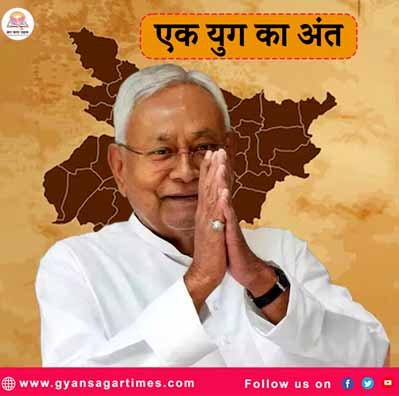
 बिहार के मुख्यमंत्री नीतीश कुमार ने राज्यसभा जाने का फैसला लिया है. क्या इसे एक युग का अंत माना जाय? बिहार की राजनीति में नीतीश कुमार एक ऐसी धुरी रहे हैं, जिनके इर्द-गिर्द पिछले दो दशकों का इतिहास बुना गया है.
वर्ष 2026 की होली से एक दिन पहले बिहार की राजनीति परिदृश्य में एक महत्वपूर्ण मोड़ आया, जब मुख्यमंत्री नीतीश कुमार ने अपने पद से इस्तीफा देने और राज्यसभा जाने की घोषणा की. उन्होंने आपने सोशल मीडिया पोस्ट पर राज्य सभा जाने की हार्दिक इच्छा के बारे में बताया साथ ही उन्होंने कहा कि, वह संसद के दोनों सदनों का सदस्य बनना चाहते थे. समाजवादी आंदोलन और लोहिया विचारधारा से प्रेरित नीतीश कुमार ने न केवल बिहार की राजनीति को एक नई दिशा दी, बल्कि अपनी अटूट राजनीतिक कुशलता से कई तूफानों को पार किया और खुद को सत्ता के केंद्र में बनाए रखा.
नीतीश कुमार का जन्म एक मार्च 1951 को बिहार के नालंदा जिले के बख्तियारपुर गाँव के एक मध्यमवर्गीय परिवार में हुआ था. वो एक इंजीनियर होने के बावजूद भी उन्होंने राजनीति को अपना कैरियर चुना. समाजवादी नेता राम मनोहर लोहिया के विचारों से प्रभावित थे नीतीश कुमार. वर्ष 1974 के जेपी आंदोलन में सक्रिय भूमिका निभाने के बाद , वे वर्ष 1985 में पहली बार बिहार विधानसभा के लिए चुने गए . वर्ष 1989 में वे पहली बार लोकसभा सांसद बने और फिर वर्ष 1999 में अटल बिहारी वाजपेयी सरकार में केंद्रीय रेल मंत्री के रूप में अपनी सेवाएं दीं. उनके राजनीतिक जीवन की यह शुरुआती पड़ाव एक कुशल प्रशासक के रूप में उनकी छवि को गढ़ने वाला था.
नीतीश कुमार पहली बार मार्च 2000 में मुख्यमंत्री बने थे, लेकिन उनका वह कार्यकाल मात्र सात दिनों का ही रहा था. उसके बाद वो वर्ष 2005 में उन्होंने भारी जनादेश के साथ सत्ता संभाल कर बिहार की तस्वीर बदलनी शुरू की. जंगलराज की समाप्ति के बाद, नीतीश कुमार ने खुद को उस युग के प्रतिपक्ष के रूप में पेश किया, जिसमें “सुशासन” और विकास ही उनके प्रमुख मुद्दे थे.
मुख्यमंत्री नीतीश कुमार के शासन की सबसे बड़ी उपलब्धियों में महिला सशक्तिकरण पर विशेष जोर दिया। उन्होंने महिलाओं को राजनीतिक, सामाजिक और आर्थिक रूप से सशक्त बनाने के लिए कई ऐतिहासिक कदम उठाए. वर्ष 2006 में में पंचायती राज संस्थाओं में महिलाओं के लिए 50% आरक्षण की शुरुआत की गई साथ ही ‘मुख्यमंत्री बालिका साइकिल योजना’. इस योजना ने लड़कियों की शिक्षा के नए पंख दिए, जिससे स्कूलों में उनकी उपस्थिति में जबरदस्त वृद्धि हुई साथ ही जीविका योजना के माध्यम से लाखों महिलाओं को स्वयं सहायता समूहों से जोड़कर उन्हें आत्मनिर्भर बनाया गया.
मुख्यमंत्री कुमार ने बिहार में सड़कों और पुलों के निर्माण पर अभूतपूर्व जोर दिया साथ ही ग्रामीण क्षेत्रों को शहरों से जोड़ने वाले संपर्क मार्गों के जाल को बिछाने का काम शुरू हुआ जिससे राज्य का चेहरा ही बदल गया. उन्होंने सीतामढ़ी जैसे पिछड़े जिले में बागमती नदी पर पुल बनाकर बाढ़ के मौसम में कटने वाले क्षेत्रों की समस्या स्थायी रूप से समाधान किया. मुख्यमंत्री कुमार के शासन में राज्य में कानून का राज स्थापित करने की दिशा में कई ठोस प्रयास हुए, जिससे अपराध और अराजकता में कमी आई. उनकी सरकार ने ‘7 निश्चय’ जैसी योजनाओं के तहत युवाओं और महिलाओं के लिए रोजगार के अवसर सृजित करने और बिहार को एक विकसित राज्य बनाने का लक्ष्य रखा. उन्होंने वर्ष 2016 से राज्य में पूर्ण शराबबंदी लागू किया जो अत्यंत ही विवादास्पद था. लेकिन यह एक महत्वपूर्ण फैसला भी रहा. इस फैसले के कारण महिलाओं में उनकी लोकप्रियता और इजाफा हुआ.
नीतीश कुमार की पहचान एक ऐसे कुशल रणनीतिकार के रूप में रही है जो हमेशा सत्ता के केंद्र में बने रहे, चाहे कोई भी गठबंधन रहा हो.
गठबंधनों का इतिहास:-
- वर्ष 1996 में भाजपा से हाथ मिलाया.
- वर्ष 2013 में नरेंद्र मोदी को प्रधानमंत्री पद का उम्मीदवार बनाए जाने के बाद एनडीए से नाता तोड़ लिया.
- वर्ष 2015 में लालू प्रसाद यादव के राजद और कांग्रेस के साथ ‘महागठबंधन’ बनाकर भारी जीत हासिल की.
- वर्ष 2017 में भ्रष्टाचार के आरोपों का हवाला देते हुए फिर से भाजपा के साथ सरकार बना ली.
- वर्ष 2022 में एक बार फिर महागठबंधन में लौटे.
- वर्ष 2024 में पुनः एनडीए का दामन थाम लिया.
बार-बार के राजनीतिक दल बदलने के कारण उनके आलोचकों ने उन्हें “पलटू राम” की उपाधि दी. लेकिन उनके समर्थकों के लिए यह उनकी राजनीतिक चतुराई और बिहार की अस्थिर राजनीति में खुद को प्रासंगिक बनाए रखने की उनकी अद्वितीय क्षमता को भी दर्शाता है. उनके इस कौशल ने उन्हें बार-बार बार सत्ता के शीर्ष पर बने रहने का अवसर मिला और वे 10वीं बार मुख्यमंत्री पद की शपथ लेने वाले एकमात्र नेता बन गए.
बताते चलें कि, नीतीश कुमार ने बिहार की जाति-आधारित राजनीति को गहराई से समझा और उसे नए आयाम भी दिए. वो खुद भी एक अल्पसंख्यक ओबीसी होने के बावजूद, उन्होंने ओबीसी समुदाय को दो वर्गों – पिछड़ा और अति पिछड़ा – में वर्गीकृत करके राजद के यादव वर्चस्व को चुनौती दी. इसी रणनीति के तहत उन्होंने अति पिछड़ा वर्ग का एक बड़ा वोट बैंक बना लिया जो उनके दो दशकों के शासन का भी आधार बना. नीतीश कुमार ने महिलाओं को भी एक पहचान और शक्ति के रूप में विकसित किया. वहीँ, महिलाओं ने भी जातिगत समीकरणों से ऊपर उठकर उन्हें समर्थन दिया.
किसी भी नेता के युग का अंत तब शुरू होता है जब उसकी राजनीतिक ‘यूएसपी खत्म होने लगती है. नीतीश कुमार के साथ भी यही हो रहा है – ज्ञात है कि, वर्ष 2005 में जदयू की जो ताकत थी वो वर्ष 2020 के चुनाव में तीसरे नंबर की पार्टी बनकर रह गई. उम्र के साथ नीतीश कुमार की थकान साफ दिख रही है और प्रशासन पर उनकी वह पुरानी ‘पकड़’ अब दिखाई नहीं देती है साथ ही शराबबंदी जैसे फैसलों ने राजस्व का नुकसान किया और पुलिसिया भ्रष्टाचार को भी बढ़ावा दिया. एक तरफ बिहार की जनता के पास तेजस्वी यादव के रूप में एक युवा विकल्प के साथ भाजपा के रूप में एक मजबूत संगठनात्मक ढांचा भी मौजूद है. वहीँ, नीतीश कुमार अब ‘बड़े भाई’ की भूमिका से हटकर ‘सहयोगी’ की भूमिका में सिमट गए.
नीतीश कुमार का राजनीतिक सफर बिहार के लिए एक मिश्रित अनुभव रहा. उनके सुशासन और विकास की छवि के साथ-साथ गठबंधन राजनीति की आलोचना भी. नीतीश कुमार के राज्यसभा जाने के फैसले ने बिहार की सत्ता की समीकरणों को पूरी तरह से बदल दिया है. एक तरफ भाजपा को को अपना मुख्यमंत्री बनाने का रास्ता साफ हो गया वहीँ, नीतीश कुमार के बेटे निशांत को जद (यू) का नया चेहरा बनाकर राजनीति में उतारने की भी चर्चा है.
नीतीश कुमार ने बिहार को अराजकता से निकालकर विकास की पटरी पर खड़ा किया. हालांकि, उनके राजनीतिक अंतर्विरोधों ने उनकी ऐतिहासिक उपलब्धियों को धुंधला कर दिया है. उनका राज्यसभा जाना न केवल व्यक्तिगत निर्णय है बल्कि बिहार की राजनीति में एक युगांतकारी मोड़ भी…
संजय कुमार सिंह,
राजनितिक एडिटर,
ज्ञानसागरटाइम्स.
========== ========= ===========
The End of an Era: Nitish Kumar
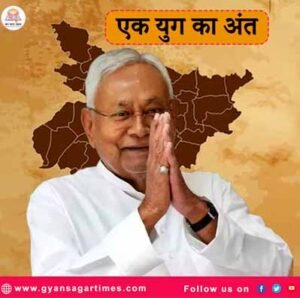
Bihar Chief Minister Nitish Kumar has decided to move to the Rajya Sabha. Should this be considered the end of an era? In the landscape of Bihar politics, Nitish Kumar has served as a central pivot around which the history of the last two decades has been woven.
Just one day before Holi in 2026, a significant turning point occurred in the political landscape of Bihar when Chief Minister Nitish Kumar announced his decision to resign from his post and move to the Rajya Sabha. In a social media post, he expressed his heartfelt desire to join the Rajya Sabha, adding that he had always aspired to become a member of both houses of Parliament. Inspired by the socialist movement and the ideology of Ram Manohar Lohia, Nitish Kumar not only steered Bihar’s politics in a new direction but also, through his unwavering political acumen, weathered numerous storms and successfully maintained his position at the very center of power.
Nitish Kumar was born on March 1, 1951, into a middle-class family in the village of Bakhtiyarpur, located in the Nalanda district of Bihar. Despite being an engineer by profession, he chose politics as his career path. Nitish Kumar was deeply influenced by the ideas of the socialist leader Ram Manohar Lohia. After playing an active role in the JP Movement of 1974, he was elected to the Bihar Legislative Assembly for the first time in 1985. In 1989, he became a Member of Parliament (MP) in the Lok Sabha for the first time, and subsequently, in 1999, he served as the Union Minister for Railways in the government led by Atal Bihari Vajpayee. These early stages of his political career were instrumental in shaping his image as a capable administrator.
Nitish Kumar first assumed the office of Chief Minister in March 2000, though that particular tenure lasted for a mere seven days. Subsequently, in 2005, backed by a massive public mandate, he took the reins of power and began the process of transforming the face of Bihar. Following the end of the “Jungle Raj” (lawless era), Nitish Kumar positioned himself as the counterpoint to that period—an era in which “Good Governance” and development became his primary political planks.
Among the most significant achievements of Chief Minister Nitish Kumar’s administration was the special emphasis placed on women’s empowerment. He took several historic steps to politically, socially, and economically empower women. In 2006, a 50% reservation for women was introduced in Panchayati Raj Institutions, alongside the launch of the ‘Mukhyamantri Balika Cycle Yojana’ (Chief Minister’s Girls’ Bicycle Scheme). This scheme gave new wings to girls’ education, leading to a tremendous increase in their school attendance; furthermore, through the ‘Jeevika’ scheme, millions of women were linked to Self-Help Groups, thereby making them self-reliant.
Chief Minister Kumar placed unprecedented emphasis on the construction of roads and bridges in Bihar. Simultaneously, work began on laying down a network of link roads connecting rural areas to cities—an initiative that completely transformed the face of the state. By constructing a bridge over the Bagmati River in a backward district like Sitamarhi, he permanently resolved the problem of areas becoming cut off during the flood season. Under Chief Minister Kumar’s administration, several concrete efforts were undertaken to establish the rule of law in the state, resulting in a decline in crime and lawlessness. Through schemes such as the ‘7 Nischay’ (Seven Resolves), his government set the objective of creating employment opportunities for the youth and women, and of transforming Bihar into a developed state. In 2016, he implemented a complete prohibition on alcohol in the state—a measure that proved to be highly controversial. Nevertheless, it also stood as a significant decision. This decision further bolstered his popularity among women.
Nitish Kumar has established a reputation as a shrewd strategist who has consistently remained at the center of power, regardless of the prevailing political alliance.
A History of Alliances:
- In 1996, he joined hands with the BJP.
- In 2013, he severed ties with the NDA after Narendra Modi was named the alliance’s Prime Ministerial candidate.
- In 2015, he achieved a resounding victory by forming a ‘Grand Alliance’ (Mahagathbandhan) with Lalu Prasad Yadav’s RJD and the Congress party.
- In 2017, citing allegations of corruption, he once again formed a government in alliance with the BJP.
- In 2022, he returned to the Grand Alliance once more.
- In 2024, he rejoined the NDA fold.
Due to his frequent switching of political allegiances, his critics have bestowed upon him the moniker “Paltu Ram” (The Turncoat). However, to his supporters, this reflects his political astuteness and his unparalleled ability to remain relevant amidst the volatile political landscape of Bihar. This very skill has repeatedly enabled him to remain at the pinnacle of power, making him the only leader to have taken the oath as Chief Minister for the tenth time.
It is worth noting that Nitish Kumar possessed a profound understanding of Bihar’s caste-based politics and gave it new dimensions. Despite belonging to a minority OBC (Other Backward Classes) group himself, he challenged the RJD’s dominance—which was rooted in the Yadav community—by further classifying the OBC population into two distinct categories: ‘Backward’ and ‘Extremely Backward’ classes. Through this strategy, he successfully cultivated a massive vote bank among the Extremely Backward Classes, which subsequently served as the bedrock of his two-decade-long tenure in power. Furthermore, Nitish Kumar empowered women, elevating their status to that of a distinct political identity and a force to be reckoned with. In turn, women transcended traditional caste equations to extend their unwavering support to him.
The twilight of any political leader’s era typically begins when their unique political selling proposition (USP) starts to lose its potency. This appears to be precisely what is unfolding in the case of Nitish Kumar; notably, the formidable strength the JD(U) commanded in 2005 had diminished to such an extent that, by the 2020 assembly elections, the party was relegated to the position of the third-largest political force in the state. With advancing age, Nitish Kumar’s fatigue is clearly visible, and his erstwhile ‘grip’ on the administration is no longer apparent. Furthermore, decisions such as the liquor ban have resulted in revenue losses while simultaneously fueling police corruption. On one hand, the people of Bihar now have a youthful alternative in the form of Tejashwi Yadav, alongside the BJP, which possesses a robust organizational structure. Conversely, Nitish Kumar has now stepped aside from the role of the ‘Big Brother,’ confining himself to the role of a mere ‘ally.’
Nitish Kumar’s political journey has been a mixed experience for Bihar, characterized by his image of good governance and development, yet also marked by criticism regarding coalition politics. Nitish Kumar’s decision to move to the Rajya Sabha has completely altered the equations of power in Bihar. While this move has cleared the path for the BJP to install its own Chief Minister, there is also growing speculation about launching Nitish Kumar’s son, Nishant, into politics as the new face of the JD(U).
Nitish Kumar successfully steered Bihar out of chaos and placed it firmly on the path of development. However, his political contradictions have somewhat overshadowed his historic achievements. His move to the Rajya Sabha is not merely a personal decision, but also a watershed moment in the politics of Bihar…
Sanjay Kumar Singh,
Political Editor,
Gyansagar Times.