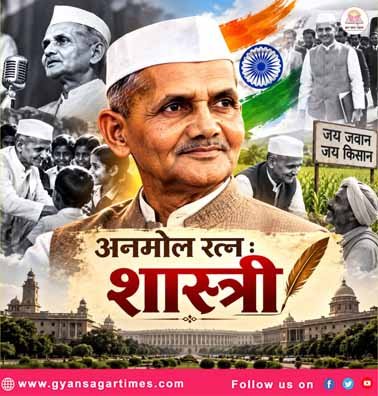
आपने रत्न- उपरत्न के बारे में सूना व देखा होगा. क्या आप अनमोल रत्न के बारे में सूना है. ईतिहास के गर्त में कई ऐसे अनमोल रत्न दर्ज हैं. आइये आज उनके जन्म दिन के अवसर पर उनके बारे में जानते हैं. आज हम बात कर रहें हैं एक ऐसे व्यक्तिव की जो वर्तमान राजनीतिज्ञों के लिए आईना है. वो साधारण पृष्ठभूमि से सत्ता के शिखर पर बैठे और सुविधाओं का संसार उन्हें विचलित ना कर सका.
भारत के दुसरे प्रधानमंत्री लाल बहादुर शास्त्री का जन्म 2 अक्टूबर, 1904 को मुगलसराय(पंडित दीन दयाल उपाध्याय नगर), उत्तर प्रदेश के एक निम्नवर्गीय परिवार में हुआ था. लाल बहादुर शास्त्री का वास्तविक नाम लाल बहादुर श्रीवास्तव था. उनके पिता शारदा प्रसाद श्रीवास्तव और माँ रामदुलारी देवी थीं. लाल बहादुर के पिता एक स्कूल में अध्यापक थे और बाद में वह इलाहबाद के आयकर विभाग में क्लर्क बन गए. कहा जाता है कि शारदा प्रसाद गरीब होने के वाबजूद भी अपनी ईमानदारी और शराफत के लिए जाने जाते थे. जब लाल बहादुर एक साल के थे तब उनके पिता का देहांत हो गया था, और उनकी माँ रामदुलारी देवी अपने दो बेटियों के साथ अपने पिता के घर आ गई, जहां लाल बहादुर का पालन-पोषण हुआ था.
17 वर्ष की उम्र में महात्मा गांधी के नेतृत्व में चल रहे स्वतंत्रता आंदोलन भाग लिया और कई बार जेल गये. कुल मिलाकर उन्होंने लगभग सात बार जेल यात्रा की और करीब नौ वर्ष कारावास में बिताए. गांधी के प्रभाव ने उनके भीतर सत्य, अहिंसा, संयम और जनसेवा की भावना को मजबूत किया. सविनय अवज्ञा आंदोलन के दौरान शास्त्री जी को गिरफ्तार कर जेल भेज दिया गया. इस दौरान उनकी बेटी गंभीर रूप से बीमार पड़ गई, जेल अधिकारियों ने कुछ समय के लिए एक शर्त पर रिहा करने को तैयार हुए परन्तु शास्त्री जी ने ये कह कर मना कर दिया कि ये उनके आत्म सम्मान के विरुद्ध है.
स्वतंत्रता के बाद वर्ष 1951 में शास्त्री जी अखिल भारतीय कांग्रेस कमेटी का महामंत्री बनाया गया, और वर्ष 1952 में वे भारत के पहले रेल मंत्री बने. रेल मंत्री के कार्यकाल के दौरान वर्ष 1956 में महबूब नगर में भीषण रेल दुर्घटना हुई जिसमें 112 लोग मारे गए. उन्होंने नैतिक जिम्मेदारी लेते हुए इस्तीफा दे दिया, परन्तु पीएम नेहरु ने इस्तीफा स्वीकार नहीं किया था. इस घटना के तीन महीने के बाद पुन: रेल दुर्घटना हुई जिसमें 114 लोग मारे गए. शास्त्री जी ने पुन: इस्तीफा दिया जिसे पीएम नेहरु ने स्वीकार कर लिया. यह घटना वर्तमान समय के राजनीति में दूर-दूर तक दीखाई नहीं देती है.
शास्त्री जी की सबसे बड़ी शक्ति थी उनकी सादगी. प्रधानमन्त्री रहने के दौरान वो धोती-कुर्ता पहनते, साइकिल पर बाजार जाते और सरकारी सुविधाओं का न्यूनतम उपयोग करते थे. उनके परिवार की आर्थिक स्थिति साधारण रही. शास्त्री जी ने अपनी ज्यादातर संपत्ति दान कर दी थी चुकि, वे गांधी जी के सच्चे अनुयायी थे. उनके जीवन में दिखावे के लिए कोई स्थान नहीं था. शास्त्री जी का मूल मंत्र था “कठिनाइयों में घबराना नहीं, बल्कि धैर्य और कर्म से आगे बढ़ना”. वर्तमान समय के राजनीति में ऐसा होना सम्भव ही नहीं है चुकि वर्तमान समय के दौर में उत्तरदायित्व का आभाव हो गया है.
9 जून 1964 को जवाहरलाल नेहरू के निधन के बाद लाल बहादुर शास्त्री भारत के दूसरे प्रधानमंत्री बने. उस दौर में देश कई संकटों के दौर से गुजर रहा था. एक तरफ आर्थिक संकट, खाद्य कमी और चीन युद्ध की हार की छाया. प्रधानमंत्री के कार्यकाल के दौरान भारत-पाकिस्तान युद्ध (वर्ष 1965) में हुआ. इस दौरान शास्त्री जी ने दृढ़ता दिखाई और भारतीय सेना को अंतरराष्ट्रीय सीमा पार करके जवाब देने की अनुमति दी. युद्ध के दौरान उन्होंने राष्ट्र को संबोधित करते हुए ऐतिहासिक नारा दिया “जय जवान, जय किसान”. यह नारा राष्ट्र निर्माण की दो आधारशिलाओं (सुरक्षा और खाद्य सुरक्षा) को जोड़ने वाला मंत्र बन गया था.
उन्होंने हरित क्रांति की नींव रखी थी. इस दौरान श्वेत क्रांति ने दूध उत्पादन को बढ़ावा दिया साथ ही अमूल तथा राष्ट्रीय डेयरी विकास बोर्ड का समर्थन भी किया. उनके कार्यकाल में जिन छह संस्थानों – राष्ट्रीय डेयरी विकास बोर्ड (एनडीडीबी), कृषि लागत एवं मूल्य आयोग, भारतीय खाद्य निगम, सीमा सुरक्षा बल, केंद्रीय सतर्कता आयोग और केंद्रीय जाँच ब्यूरो की स्थापना हुई. इस स्नस्स्थाओं ने वर्ष 2025 में साथ वर्ष पूरा किया. इन संस्थाओं ने भारत की राजनीतिक अर्थव्यवस्था पर स्थायी प्रभाव डाला है. बताते चलें कि वर्तमान समय में प्रदर्शनों में पानी की बौछार छोड़ी जाती है. यह सुझाव भी शास्त्री जी ने ही दिया था जो वर्तमान समय इसका उपयोग किया जा रहा है.
शास्त्री जी 10 जनवरी 1966 को ताशकंद में पाकिस्तान के राष्ट्रपति अयूब खान के साथ शांति समझौते पर हस्ताक्षर किए लेकिन, समझौते के महज बारह घंटे बाद, 11 जनवरी 1966 की रात उनका निधन हुआ था. आधिकारिक रिपोर्टों में कहा गया कि दिल का दौरा पड़ने से लाल बहादुर शास्त्री का निधन हुआ. बताते चले कि शास्त्री जी के शॉ का पोस्त्मर्तम नहीं किया गया. वहीं, वरिष्ठ पत्रकार कुलदीप नैयर की किताब में इस घटना के बारे में लिखा हुआ है. वरिष्ठ पत्रकार नैयर ने लिखा कि, शास्त्री जी पहले ही दो बार दिल का दौरा पड़ चुका था और उस दिन उनका कार्यक्रम अत्यंत व्यस्त था. नैयर ने उस रात बिस्तर के पास दस फीट दूर पड़ी उलटी हुई थर्मस फ्लास्क देखी और सोचा कि क्या प्रधानमंत्री ने पानी लेने के लिए संघर्ष किया था. उनकी चप्पलें बिस्तर के पास साफ-सुथरी रखी थीं, जिसका अर्थ था कि वे नंगे पांव कालीन पर चलकर ड्रेसिंग टेबल तक गए थे.
लालबहादुर शास्त्री की मृत्यु के बाद राष्ट्रपति डॉ. एस. राधाकृष्णन ने उन्हें मरणोपरांत ‘भारत रत्न’ से सम्मानित किया. वे पहले व्यक्ति थे जिन्हें मरणोपरांत भारत रत्न से नवाजा गया था. शास्त्री जी का जीवन इस बात का प्रमाण है कि एक साधारण परिवार का बालक अपने चरित्र और कर्म के बल पर देश का सर्वोच्च पद प्राप्त कर सकता है. वर्तमान समय की राजनीति में चरित्र, सादगी और नैतिक जवाबदेही के मूल्य का आभाव होता जा रहा है. वर्तमान समय के दौर में शास्त्री जी की विरासत और भी प्रासंगिक हो जाती है चूकिं, उनका जीवन बताता है कि सत्ता का सच्चा मूल्य उसके उपयोग में है, न कि उसके भोग में है. यही कारण है कि आधी सदी के बीत जाने के बाद भी लालबहादुर शास्त्री भारत के उन अनमोल रत्नों में से एक गिने जाते हैं.
======== ========= ===========
Anmol Ratna: Lal Bahadur Shastri
You have likely heard of or seen various gemstones and semi-precious stones. But have you ever heard of “priceless gems”? History holds records of many such priceless gems—extraordinary individuals. Today, on the occasion of his birth anniversary, let us learn about one such person. We are discussing a personality who serves as a mirror for today’s politicians; he rose from a humble background to the pinnacle of power, yet the allure of a life of luxury could not sway him.
India’s second Prime Minister, Lal Bahadur Shastri, was born on October 2, 1904, into a lower-middle-class family in Mughalsarai (Pandit Deen Dayal Upadhyaya Nagar), Uttar Pradesh. His birth name was Lal Bahadur Srivastava. His parents were Sharda Prasad Srivastava and Ramdulari Devi. His father was a school teacher and later became a clerk in the Income Tax Department in Allahabad. Despite his poverty, Sharda Prasad was known for his honesty and integrity. Lal Bahadur lost his father when he was just one year old; subsequently, his mother, Ramdulari Devi, moved with her two daughters to her father’s home, where Lal Bahadur was raised.
At the age of 17, he participated in the freedom movement led by Mahatma Gandhi and was imprisoned multiple times. In total, he was jailed about seven times and spent nearly nine years in prison. Gandhi’s influence strengthened his commitment to truth, non-violence, restraint, and public service. During the Civil Disobedience Movement, Shastri Ji was arrested and imprisoned. While he was in jail, his daughter fell critically ill; prison authorities offered to release him temporarily on a specific condition, but Shastri Ji refused, stating that it went against his self-respect.
After independence, in 1951, Shastri Ji was appointed General Secretary of the All India Congress Committee, and in 1952, he became India’s first Railway Minister. During his tenure as Railway Minister, a horrific train accident occurred at Mahbubnagar in 1956, claiming 112 lives. He resigned, accepting moral responsibility, but Prime Minister Nehru did not accept the resignation. Three months later, another train accident took place, resulting in 114 deaths. Shastriji resigned again, and this time, Prime Minister Nehru accepted it. Such conduct is nowhere to be seen in contemporary politics.
Shastriji’s greatest strength was his simplicity. While serving as Prime Minister, he wore a *dhoti-kurta*, went to the market on a bicycle, and made minimal use of official perks. His family’s financial status remained modest. As a true follower of Gandhiji, Shastriji had donated most of his assets; there was no room for ostentation in his life. His guiding principle was not to panic in the face of adversity but to move forward with patience and action. Such an attitude is virtually impossible in today’s political climate, which is marked by a lack of accountability.
Lal Bahadur Shastri became India’s second Prime Minister following the demise of Jawaharlal Nehru on June 9, 1964. At that time, the country was grappling with multiple crises—including an economic downturn, food shortages, and the shadow of the defeat in the war with China. His tenure saw the outbreak of the 1965 war between India and Pakistan. Shastriji demonstrated great resolve during this period, authorizing the Indian Army to cross the international border to retaliate. While addressing the nation during the war, he coined the historic slogan “Jai Jawan, Jai Kisan” (Hail the Soldier, Hail the Farmer). This slogan became a mantra uniting the two cornerstones of nation-building: national security and food security.
He laid the foundation for the Green Revolution. During this period, the White Revolution boosted milk production, and he also extended his support to Amul and the National Dairy Development Board. Six institutions were established during his tenure: the National Dairy Development Board (NDDB), the Commission for Agricultural Costs and Prices, the Food Corporation of India, the Border Security Force, the Central Vigilance Commission, and the Central Bureau of Investigation. These institutions have had a lasting impact on India’s political economy. It is worth noting that the use of water cannons to control protests—a practice employed today—was a measure originally suggested by Shastri Ji.
On January 10, 1966, Shastri Ji signed a peace agreement with Pakistan’s President Ayub Khan in Tashkent; however, he passed away just twelve hours later, on the night of January 11, 1966. Official reports stated that Lal Bahadur Shastri died of a heart attack. Notably, no post-mortem examination was conducted on his body. Senior journalist Kuldip Nayar has written about this incident in his book, noting that Shastri Ji had previously suffered two heart attacks and had an extremely busy schedule that day. Nayar observed an overturned thermos flask lying ten feet away from the bed that night and wondered if the Prime Minister had struggled to get water. His slippers were placed neatly by the bed, implying that he had walked barefoot across the carpet to the dressing table.
Following Lal Bahadur Shastri’s death, President Dr. S. Radhakrishnan honored him posthumously with the ‘Bharat Ratna’. He was the first individual to be conferred this award posthumously. Shastri’s life stands as a testament to the fact that a child from an ordinary family can attain the nation’s highest office through the strength of his character and deeds. In contemporary politics, the values of character, simplicity, and moral accountability are increasingly lacking. Shastri’s legacy becomes even more relevant in today’s times, as his life demonstrates that the true value of power lies in its constructive use rather than in its indulgence. This is why, even after half a century, Lal Bahadur Shastri remains counted among India’s most precious gems.