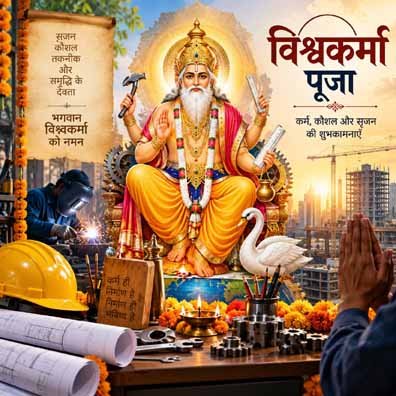
सनातन संस्कृति पूरी दुनिया में सबसे अनूठी और अनुपम है. यहाँ की सांस्कृतिक परंपराएँ केवल पूजा-पद्धतियों तक ही सीमित नहीं हैं, बल्कि वे समाज के जीवन-मूल्यों, श्रम-विभाजन, कला-कौशल और प्रकृति के प्रति दृष्टिकोण को भी अभिव्यक्त करती हैं. सनातन संस्कृति में हर मास (महिना) और उनमे दिन का एक ख़ास महत्व होता है. आज की तारीख 17 सितंबर है और आज के दिन पुरे भारतवर्ष में देवताओं के वास्तुकार, शिल्पकार और सृष्टिकर्ता भगवान् विश्वकर्मा की पूजा व आराधना बड़ी ही धूम-धाम से मनाया जा रहा है.
बृहस्पते भगिनी भुवना ब्रह्मवादिनी।
प्रभासस्य तस्य भार्या बसूनामष्टमस्य च।
विश्वकर्मा सुतस्तस्यशिल्पकर्ता प्रजापतिः॥
पौराणिक धर्मग्रन्थों के अनुसार ब्रह्मा जी के पुत्र धर्म के सातवे संतान जिनका नाम वास्तु था और वो शिल्पकार थे. वास्तु के पुत्र का नाम विश्वकर्मा था जो पिता की भांति शिल्पकार थे. ऋग्वेद में विश्वकर्मा सूक्त नाम से 11ऋचाएं लिखी गई हैं यही, सूक्त यजुर्वेद में 17 सूक्त मन्त्र 16 से 31 तक करीब 16 मन्त्र आया है. स्कन्द पुराण में एक श्लोक है जिसका अर्थ है कि, महर्षि अंगिरा के ज्येष्ठ पुत्र की बहन भुवना जो ब्रह्मविद्या की जानकार थी. जो अष्टम वसु महर्षि प्रभास की पत्नी बनी और उससे सम्पूर्ण शिल्प विद्या के ज्ञाता प्रजापति विश्वकर्मा का जन्म हुआ. पुराणों में कहीं योगसिद्धा, वरस्त्री नाम भी वृहस्पति की बहन लिखा गया है. विश्वकर्मा शब्द व अर्थ – विश्वकर्मा शब्द संस्कृत के दो शब्दों से बना है. विश्वकर्मा – विश्व और कर्म, जिसका शाब्दिक अर्थ होता है “ संसार के निर्माता या रचयिता”. यह पर्व हर वर्ष कन्या संक्रांति के दिन (आमतौर पर 17 सितंबर) को मनाया जाता है. भगवान विश्वकर्मा को ब्रह्मांड का पहला वास्तुकार और शिल्पकार माना जाता है. ऋग्वेद में उन्हें संपूर्ण सृष्टि का सृजनकर्ता और देवताओं के मुख्य शिल्पी कहे जाते हैं.
भारत में विश्वकर्मा को शिल्पशस्त्र का अविष्कार करने वाला देवता माना जाता है, जबकि चीन मे लु पान को बदइयों का देवता माना जाता है. पौराणिक ग्रन्थों के अनुसार जिसकी सम्यक् सृष्टि और कर्म व्यपार है वही विशवकर्मा है. भगवान विश्वकर्मा सृष्टि के सूत्रधार कहे गये हैं. स्कंदपुराण में उन्हें देवायतनों का सृष्टा कहा गया है. वास्तुशास्त्र के अनुसार विश्वकर्मा कंबासूत्र, जलपात्र, पुस्तक और ज्ञानसूत्र धारक हैं, हंस पर आरूढ़, सर्वदृष्टिधारक, शुभ मुकुट और वृद्धकाय हैं. पूरी दुनिया की पहली तकनिकी ग्रन्थ विश्वकर्मीय (वास्तु शास्त्र) ग्रन्थ ही माने जाते हैं. इसमें मानव और देववास्तु विद्या को गणित के कई सूत्रों के साथ बताया गया है, ये सब प्रामाणिक और प्रासंगिक हैं. इसी ग्रंथ से पता चलता है कि विश्वकर्मा ने अपने तीन अन्य पुत्रों जय, विजय और सिद्धार्थ को भी ज्ञान दिया. स्कन्द पुराण के काशी खंड में महादेव जी ने पार्वती जी से कहा है कि हे ‘पार्वती’ मैं आप से पाप नाशक कथा कहता हूं. कथा में महादेव जी ने पार्वती जी को विश्वकर्मेश्वर लिगं प्रकट होने की कथा कहते हैं. महाभारत पुराण में वर्णन मिलता है कि, भाद्रपद शुक्ला प्रतिपदा तिथि को भगवान विश्वकर्मा की पुजा अर्चना करते हैं.
ऋग्वेद के अनुसार शिल्पकारों व रचनाकारों के देवता भगवान विश्वकर्मा है जो ब्रह्मांड के भी रचियता माने जाते हैं. रावण के सौतेले भाई विश्वकर्मा हैं जो भाई के कहने पर त्रिकुट पर्वत पर सोने की लंका का निर्माण किया था. पौराणिक ग्रंथों के अनुसार विश्वकर्मा ने ही माल्यवान, माली और सुमाली नामक राक्षसों के भी महल बनाये थे. पुष्पक विमान का भी निर्माण भगवान विश्वकर्मा ने ही किया था. विश्वकर्मा ने भगवान कृष्ण के लिए द्वारिका नगरी का निर्माण किया था. उसके अलावा उन्होंने कई पुरियों का निर्माण, देवो के महल व दैनिक उपयोग में होने वाली वस्तुओं का निर्माण किया. बिहार के औरंगबाद स्थित देव सूर्य मंदिर व देवघर स्थित बैद्यनाथ मंदिर का भी निर्माण भगवान विश्वकर्मा ने किया था.
21वीं सदी यानी आधुनिक युग में भी भगवान विश्वकर्मा की पूजा व आराधना बड़ी ही धूम-धाम से मानी जाती है लेकिन, आधुनिक युग में अब पूजा प्रकृति और पर्यावरण के विपरीत जाकर हो रही है. इस अवसर पर बड़े पैमाने पर सजावट, प्लास्टिक सामग्री, रासायनिक रंग का प्रयोग बढ़ रहा है जिसके कारण पर्यावरण दूषित हो रहा है. वर्तमान समय में निर्माण-कौशल का स्वरूप अत्यंत बदल चुका है. जहाँ रोबोटिक्स, कृत्रिम बुद्धिमत्ता, 3D प्रिंटिंग, कंप्यूटर-सहायित डिजाइन, स्वचालन और डिजिटल विनिर्माण जैसी तकनीकों ने उत्पादन की प्रकृति को ही बदल दिया है.
किसी भी देश की अर्थव्यवस्था और संस्कृति में कारीगरों की भूमिका ऐतिहासिक रूप से महत्वपूर्ण रही है. वहीं, भारतीय समाज में लंबे समय तक शारीरिक श्रम और बौद्धिक श्रम के बीच सामाजिक अंतर रहा है. चुकि, विश्वकर्मा पूजा का महत्व केवल धार्मिक आस्था में नहीं, बल्कि इस विचार में भी निहित है कि मनुष्य की सृजनात्मक और तकनीकी क्षमता समाज के विकास की आधारशिला है. जिस प्रकार औजार, मशीन, भवन, वाहन और उत्पादन के साधन केवल निर्जीव वस्तुएँ नहीं माने जाते; उनके पीछे मनुष्य के श्रम, कौशल, ज्ञान और रचनात्मकता का योगदान होता है.
भारतीय समाज में विश्वकर्मा की छवि इस विश्वास को मजबूत करती है कि निर्माण और शिल्प केवल आर्थिक गतिविधियाँ नहीं, बल्कि ज्ञान और कौशल की अभिव्यक्तियाँ भी हैं. किसी वस्तु को बनाना केवल शारीरिक श्रम का कार्य नहीं है बल्कि,उसमें अनुभव, गणना, कल्पना, तकनीक और दक्षता का भी समन्वय होता है. इसलिए विश्वकर्मा पूजा को श्रम और सृजन के सम्मान के पर्व के रूप में देखा जाता है.
विश्वकर्मा पूजा केवल एक धार्मिक अनुष्ठान नहीं है, बल्कि यह श्रम की गरिमा का सबसे बड़ा उत्सव है. यह पूजा सनातन संस्कृति में परंपरा और आधुनिकता के बीच एक महत्वपूर्ण संवाद प्रस्तुत करती है. वर्तमान समय में जब दुनिया तेजी से तकनीकी और औद्योगिक परिवर्तन से गुजर रही है, तब इस पर्व का महत्व नए रूप में समझा जा सकता है. इस पूजा में केवल प्रतिमा की पूजा या मशीनों पर फूल चढ़ाने में नहीं निहित है बल्कि, इसका व्यापक सामाजिक संदेश है जो सभी मनुष्यों के श्रम का सम्मान करने की भी प्रेरणा देता है. हमें यह सिखाता है कि जो हाथ से काम करते हैं और जो मशीनें उत्पादन करती हैं, वे समाज की रीढ़ हैं. वैसे तो देखा जाय तो विश्वकर्मा पूजा का सही अर्थ है कर्म ही पूजा है के आदर्श का जीवंत उत्सव है. वर्तमान समय के आधुनिक जीवन में विश्वकर्मा पूजा को प्रकृति के सम्मान के साथ मनाया जाय तो इसकी गरिमा और संस्कृति बनी रहेगी.
========== ========= ===========
Vishwakarma puja
Sanatan culture is one of the most unique and incomparable in the entire world. Its cultural traditions are not limited to worship practices, but also express the society’s life values, division of labor, arts and crafts, and attitude towards nature. In Sanatan culture, every month and day within it holds special significance. Today is September 17th, and on this day, Lord Vishwakarma, the architect, craftsman, and creator of the gods, is being worshipped and revered with great pomp and show across India.
Brihasapate Bhagini Bhuvanaa Brahmavadini|
Prabhasasy Tasy Bharya Basunamashtamsy|
Vishwakarma Sutstsyshilpakrta Prajapati: ||
According to ancient scriptures, the seventh child of Brahma’s son Dharma was named Vastu, a craftsman. Vastu’s son was Vishwakarma, who, like his father, was a craftsman. The Rigveda contains 11 hymns called the Vishwakarma Sukta. The Yajurveda contains 17 hymns, with approximately 16 mantras from Sukta 16 to 31. The Skanda Purana contains a verse that describes Bhuvana, the sister of Maharishi Angira’s eldest son, who was an expert in Brahmavidya (the science of Brahman). She became the wife of Maharishi Prabhas, the eighth Vasu, and gave birth to Prajapati Vishwakarma, a master of all craftsmanship. In other Puranas, the names Yogasiddha and Varastri are also mentioned as Brihaspati’s sister. The word Vishwakarma is derived from two Sanskrit words: Vishwakarma (world) and Karma, which literally means “creator of the world.” This festival is celebrated every year on the day of Kanya Sankranti (usually September 17th). Lord Vishwakarma is considered the first architect and craftsman of the universe. In the Rigveda, he is described as the creator of the entire universe and the chief architect of the gods.
In India, Vishwakarma is considered the god who invented the weapon of craft, while in China, Lu Pan is considered the god of weavers. According to mythological texts, the one who has proper creation and business is Vishwakarma. Lord Vishwakarma is called the architect of creation. In the Skanda Purana, he is described as the creator of temples. According to Vastu Shastra, Vishwakarma holds the Kanbhasutra, water pot, book, and Gyansutra, rides on a swan, possesses all-seeing eyes, has an auspicious crown, and is old in stature. The Vishwakarma (Vastu Shastra) is considered the world’s first technical text. In this, human and divine architecture has been explained with many mathematical formulas, all of which are authentic and relevant. It is known from this book that Vishwakarma also imparted knowledge to his three other sons Jai, Vijay and Siddhartha. In the Kashi section of Skanda Purana, Mahadev ji has said to Parvati ji that O Parvati, I will tell you the story that destroys sins. In the story, Mahadev ji tells Parvati ji the story of the appearance of Vishwakarmeshwar Linga. It is described in Mahabharata Purana that, on Bhadrapada Shukla Pratipada date, Lord Vishwakarma is worshipped.
According to the Rigveda, Lord Vishwakarma is the god of craftsmen and creators, who is also considered the creator of the universe. Vishwakarma, Ravana’s half-brother, built the golden Lanka on Trikuta Mountain at his brother’s behest. According to mythological texts, Vishwakarma also built the palaces of the demons Malyavan, Mali, and Sumali. Lord Vishwakarma also constructed the Pushpak Vimana. Vishwakarma built the city of Dwarka for Lord Krishna. He also constructed numerous cities, palaces for the gods, and items of daily use. Lord Vishwakarma also built the Dev Surya Temple in Aurangabad, Bihar, and the Baidyanath Temple in Deoghar.
Even in the 21st century, the worship of Lord Vishwakarma is celebrated with great pomp and show, but this modern era is now being conducted in a manner that is contrary to nature and the environment. The use of large-scale decorations, plastic materials, and chemical dyes is increasing on this occasion, polluting the environment. In modern times, the nature of construction skills has changed dramatically. Technologies like robotics, artificial intelligence, 3D printing, computer-aided design, automation, and digital manufacturing have transformed the very nature of production.
The role of artisans has historically been crucial in a country’s economy and culture. At the same time, Indian society has long maintained a social distinction between manual labor and intellectual labor. The significance of Vishwakarma Puja lies not only in religious belief, but also in the idea that human creativity and technical abilities are the foundation of society’s development. Just as tools, machines, buildings, vehicles, and means of production are not merely inanimate objects; they are the result of human labor, skill, knowledge, and creativity.
The image of Vishwakarma in Indian society reinforces the belief that construction and crafts are not merely economic activities but also expressions of knowledge and skill. Creating an object is not merely a matter of physical labor; it also involves a combination of experience, calculation, imagination, technology, and expertise. Therefore, Vishwakarma Puja is seen as a festival honoring labor and creation.
Vishwakarma Puja is not merely a religious ritual, but the greatest celebration of the dignity of labor. This puja represents an important dialogue between tradition and modernity in Sanatan culture. In today’s times, when the world is undergoing rapid technological and industrial change, the significance of this festival can be understood in a new way. This puja is not merely about worshipping idols or offering flowers to machines; rather, it has a broader social message that inspires respect for the labor of all human beings. It teaches us that those who work with their hands and those who produce machines are the backbone of society. In essence, Vishwakarma Puja is a living celebration of the ideal that work is worship. In today’s modern life, if Vishwakarma Puja is celebrated with respect for nature, its dignity and culture will remain intact.