भारतीय संस्कृति में दोस्ती का एक अलग अंदाज है. यहाँ दोस्ती को कृष्ण और सुदामा के रूप में देखा जाता है. वहीं, दोस्ती पर एक गाना भी याद आ रहा है. गाने के बोल है – ये दोस्ती हम नहीं तोड़ेंगे… तोड़ेंगे दम मगर, तेरा साथ ना छोड़ेंगे! अगर हम बात करें, दुनिया के सबसे पुराने और सबसे बड़े लोकतंत्रों की… जब भी मुलाकात होती है, तो बैकग्राउंड में शहनाई नहीं, बल्कि कूटनीति का ‘वायलिन’ बजता है. अगर बात करें भारत की तो…यहां ‘अतिथि देवो भव’ के तहत दोस्ती का धर्म निभाया जाता है वहीं, अमेरिका की बात करें तो…वहाँ हर दोस्ती में पहले ‘रिटर्न ऑन इन्वेस्टमेंट’ को देखा जाता है. इस अनोखे रिश्ते पर, जहाँ दोस्ती का धर्म कभी-कभी ‘गुलामी की नई डिजिटल तकदीर’ जैसा दीखने लगता है.
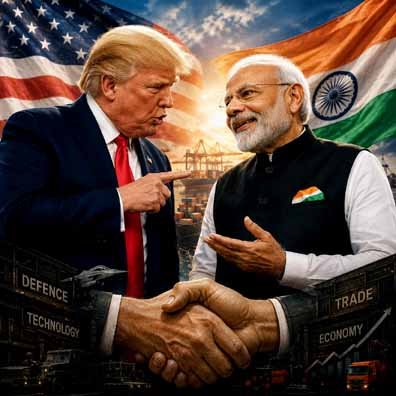
दुनिया में दोस्ती का भी एक धर्म है, कभी दोस्ती बराबरी वालों में होती थी जो एक-दूसरे के सुख-दुख में साथ खड़े होते थे वहीं, वर्तमान समय का आलम ये है कि, तुम मुझे ज्यादा फायदा दो तो अच्छे दोस्त हो वर्ना… मैं तुम्हें जानता भी नहीं हूँ. हम बात कर रहें हैं अमेरिका और भारत के सम्बन्धों या यूँ कहें कि, नरेंद्र मोदी का डोनाल्ड ट्रंप के दोस्ती की… वैसे तो देखा जाय तो..नरेंद्र मोदी का डोनाल्ड ट्रंप के दोस्ती की… तो देखकर ऐसा लगता है कि, ये दोस्ती का आधुनिक संस्करण हैं. जहां एक दोस्त आदेश देता है, दूसरा मुस्कुराकर उसे “रणनीतिक साझेदारी” कह देता है. अगर कोई पूछे तो कि, “ इसमें बराबरी कहां है ”, तो जवाब मिलता है कि “यह नई विश्व व्यवस्था है, इसे समझने के लिए पुरानी समझ छोड़नी पड़ेगी”.
पूरी दुनिया में अमेरिका एक ढोल पिटता है कि, वो लोकतंत्र का सबसे बड़ा पुजारी है और पूरी दुनिया को लोकतंत्र का पाठ भी पढाता है जिसमें किताबें भी उसी की अपनी लिखी हुई होती है. जहाँ उसके हित सुरक्षित हों, वहाँ लोकतंत्र “विश्व का उज्ज्वल भविष्य” बन जाता है और जहाँ हितों पर आँच आए, वहाँ, वही लोकतंत्र “आंतरिक मामला” घोषित कर दिया जाता है. अमेरिका का सच्चा दोस्त भारत है चूकिं, भारत के पास 140 करोड़ उपभोक्ताओं का विशाल बाज़ार है. जब तक भारतीय युवा अमेरिकी आईफोन खरीद रहे हैं, नेटफ्लिक्स देख रहे हैं और सिलिकॉन वैली को अपने दिमाग से सींच रहे हैं, तब तक हमारी “रणनीतिक साझेदारी” अमर है.
वैसे तो देखा जाय तो भारत में दोस्ती का मतलब होता है जहाँ सुख-दुख में साथ निभाना वहीँ, अमेरिकी शब्दकोश में ‘दोस्ती’ का मतलब थोड़ा अलग है. चूकिं, वहाँ दोस्ती का धर्म ‘व्हाइट हाउस’ के नियमों से चलता है. जब दोनों देश मंच पर आकर हाथ ऐसे मिलाते हैं जैसे कि,बचपन के लंगोटिया यार हों. लेकिन जैसे ही भारत रूस से थोड़ा सस्ता तेल खरीद लेता है, अमेरिकी दोस्ती का ‘धर्म’ अचानक ‘लोकतंत्र की चिंता’ और ‘प्रतिबंधों की धमकी’ वाले मोड में स्विच हो जाता है. वहीँ, बात हो गुलामी कि, तो पुराने जमाने में गुलामी के लिए सेनाएँ भेजनी पड़ती थीं, गवर्नर जनरल आते थे, और बकायदा लगान भी वसूलना पड़ता था. वर्तमान समय का आलम ये है कि, अमेरिका ने इस प्रक्रिया को बेहद ‘यूज़र-फ्रेंडली’ बना दिया है. जिसे हम सभी ‘डिजिटल गुलामी’ कह सकते हैं.
वर्तमान समय का आलम यह है कि, भारत का कीमती डेटा (हमारी पसंद, नापसंद, हमारी बातें, हमारी रील्स) यह सब कैलिफ़ोर्निया के सर्वरों में जाकर सुरक्षित हो जाता है. ठीक उसी प्रकार पूर्व में भी ईस्ट इंडिया कंपनी मसाले ले जाती थी, और ‘न्यू इंडिया’ से अमेरिकी बिग टेक कंपनियाँ ‘डेटा’ ले जा रही हैं. दूसरी तरफ अगर देखें तो, भारत के सबसे बुद्धिमान इंजीनियर, डॉक्टर और वैज्ञानिक एच-1बी (H-1B) वीजा की कतार में लगकर अपनी तकदीर का फैसला करवाते हैं. ग्रीन कार्ड की प्रतीक्षा सूची इतनी लंबी है कि इंसान की दो पीढ़ियाँ सिर्फ इस डर से गुजार देती हैं कि कहीं छंटनी न हो जाए. क्या यह तकदीर गुलामी के किसी आधुनिक संस्करण से कम है?
अगर हम बात करें रणनीतिक चाल की तो… अमेरिका के दोस्ती के धर्म की सबसे बड़ी परीक्षा ‘वैश्विक राजनीति’ के अखाड़े में होती है “जब तक चीन है तब तक तुम मेरे भाई हो”. अमेरिका का प्यार तब बढ़ता है जब उसे चीन को डराना होता है. वो दूर से ही कहता है कि, “हम स्थिति पर नजर रख रहे हैं, तुम बहुत बहादुर हो! वहीँ बात हो युक्रेन संकट की तो… युक्रेन संकट में अगर भारत गुटनिरपेक्ष रहता है अमेरिका कहता है कि “यह लोकतंत्र की पीठ में छुरा घोंपने जैसा है”. इस रणनीतिक खेल में भारत को अक्सर ‘फ्रंटलाइन स्टेट’ की तरह इस्तेमाल करने की कोशिश की जाती है. अमेरिका चाहता है कि भारत क्वाड (QUAD) में भी नाचे, हिंद महासागर में पहरेदारी भी करे, लेकिन जब तकनीक ट्रांसफर या पेटेंट अधिकारों में छूट देने की बात आए, तो अमेरिका को ‘बौद्धिक संपदा’ की बीमारी हो जाती है.
सबसे अच्छा दृश्य देखने को तब मिलता है जब जब दोनों देश एक-दूसरे की प्रशंसा करते हैं. एक तरफ अमेरिका भारत को “विश्व का सबसे बड़ा लोकतंत्र” कहता है, और भारत अमेरिका को “सबसे विश्वसनीय साझेदार”. दोनों मुस्कुराते हैं, संयुक्त बयान जारी होता है साथ ही कैमरे चमकते हैं. वहीँ, दूसरी तरफ बंद कमरे में व्यापार, रणनीति, प्रतिबंध, शुल्क और सुरक्षा की लंबी सूची खुल जाती है. एक तरफ दुनिया को दोस्ती की तस्वीर दिखाई जाती है ठीक इसके विपरीत हितों की गिनती भी की जाती है.
वर्तमान समय में दोस्ती का सबसे बड़ा प्रमाण है हथियारों की खरीद. पूर्व में मित्र एक-दूसरे को किताबें, विचार या संस्कृतियाँ देते थे लेकिन, वर्तमान समय में मिसाइलें, ड्रोन और रक्षा समझौते देते हैं. वर्तमान समय में जितना बड़ा सौदा, उतनी गहरी दोस्ती है. वर्तमान समय में व्यापार ही आधुनिक दोस्ती का नया स्वरूप है. जहाँ अमेरिका कहता है कि, “हम मुक्त व्यापार के समर्थक हैं”. लेकिन जब किसी और की वस्तुएँ उसके उद्योगों को चुनौती देने लगें, तब मुक्त व्यापार अचानक सुरक्षा का विषय बन जाता है. वहीँ, भारत भी जबाव में कहता है कि, “हम आत्मनिर्भर हैं”. ठीक इसके विपरीत बात हो विदेशी निवेशकों की तो भारत उसके स्वागत में लाल कालीन बिछा देता है.
अगर हम सांस्कृतिक मोर्चे की बात करें तो… यहाँ पर भी गुलामी की तकदीर इतनी गहरी हो चुकी है कि अब हमें खुद पर गर्व करने के लिए भी अमेरिकी मुहर की जरूरत होती है. चूकिं, हमारे विचार ऐसे हैं कि, जब तक कोई भारतीय फिल्म ‘ऑस्कर’ की दहलीज पर जाकर सलाम न ठोक आए, तब लोग उसे मास्टरपीस नहीं मानते हैं. अगर बात करें त्योहारों की तो वर्तमान समय में त्योहारों का भी अमेरिकीकरण हो गया है. दोस्ती का धर्म निभाते-निभाते हम अपनी दीवाली के दीयों से ज्यादा अमेरिकी ‘ब्लैक फ्राइडे सेल’ के डिस्काउंट का इंतजार करने लगतें हैं.
वर्तमान समय में भाषा भी गुलाम हो गई है. वर्तमान समय के भारत में ज्ञान की कसौटी इतनी ही रह गई है कि आप अमेरिकी लहजे में कितनी तेजी से अंग्रेजी बोल सकते हैं. बताते चलें कि, अंतरराष्ट्रीय राजनीति में स्थायी मित्र नहीं, स्थायी हित होते हैं. समस्या तब पैदा होती है जब जनता से हितों की राजनीति को भावनाओं की दोस्ती के रूप में प्रस्तुत किया जाता है. यदि संबंध बराबरी, पारदर्शिता और राष्ट्रीय हितों के आधार पर हों, तो वे साझेदारी कहलाते हैं. लेकिन, जब आत्मसम्मान की जगह निर्भरता और विवेक की जगह अंधा अनुसरण आ जाए, तो लोग उसे “दोस्ती” नहीं, “सुसंस्कृत गुलामी” कहने लगते हैं.
वैसे तो देखा जाय तो भारत और अमेरिका का संबंध ना तो किसी प्रेम कथा की तरह है ना किसी शत्रुता की कहानी. ये शतरंज की वो बिसात है जहाँ हर चाल के पीछे राष्ट्रीय हित छिपा होता है. फर्क सिर्फ इतना है कि आवाम को अक्सर यह विश्वास दिलाया जाता है कि मोहरे अपनी मर्जी से ही चल रहे हैं. वर्तमान समय का ये आलम है कि, भारत-अमेरिका संबंध अब दीर्घकालिक रणनीतिक अभिसरण से हटकर “अमेरिका फर्स्ट” संरक्षणवाद से तनावपूर्ण, अस्थिर और लेन-देन-आधारित संबंधों में परिवर्तित हो गया है. एक यक्ष प्रश्न खड़ा हो रहा है कि, क्या भारत एक ऐसी “दोस्ती” का खर्च वहन कर सकता है जहाँ उसकी “रणनीतिक स्वायत्तता” बार-बार समझौता करती प्रतीत होती है? या फिर यह “गुलामी” नहीं बल्कि वैश्विक राजनीति की वास्तविकता है कि किसी भी छोटी या मध्यम शक्ति को एक महाशक्ति के साथ संबंधों में कुछ न कुछ त्याग करना ही पड़ता है?
भारत और अमेरिका के दोस्ती का कड़वा सच यह है कि, भारत इस दोस्ती को ‘धर्म’ मानकर अपनी पूरी आत्मा और बाज़ार दांव पर लगा देता है, जबकि अमेरिका इसे एक ‘कॉन्ट्रैक्ट’ मानकर चलता है जिसकी हर पांच वर्ष में समीक्षा होती है. इस अनोखे रिश्ते पर, जहाँ दोस्ती का धर्म कभी-कभी ‘गुलामी की नई डिजिटल तकदीर’ जैसा लगने लगता है. वैसे तो, भारत और अमेरिका की दोस्ती भी कुछ ऐसी ही है. यह दोस्ती उतनी ही दिलचस्प है जितनी किसी गाँव के पहलवान और उसके दुबले-पतले चेले की. “दोस्ती” और “गुलामी” के बीच की यह रेखा संभवतः भारत-अमेरिका संबंधों की सबसे बड़ी अनिश्चितता बनी रहेगी… चूकिं, अमेरिका का एक नियम है चाहे दोस्त कितना भी ‘परम मित्र’ क्यों न हो ! परन्तु वहां भोजन मुफ्त में नहीं मिलता है. उसके लिए भी कीमत चुकानी पड़ती है.
भुसा@
========== ========= ===========
The duty of friendship and the destiny of servitude…
Friendship holds a unique place in Indian culture, often exemplified by the bond between Krishna and Sudama. A song comes to mind here: “We will not break this friendship… we might even breathe our last, but we will never forsake your company.” When we speak of the world’s oldest and largest democracies, their meetings are accompanied not by the festive “shehnai”, but by the ‘violin’ of diplomacy. In India, the duty of friendship is upheld through the ethos of “Atithi Devo Bhava” (treating the guest as God), whereas in America, every friendship is weighed against the ‘return on investment.’ It is a peculiar relationship where the duty of friendship can sometimes start to resemble a ‘new digital form of servitude.’
There is a certain code to friendship in the world; historically, it existed between equals who stood by each other through joy and sorrow. Today, however, the prevailing attitude is: “If you benefit me greatly, you are a good friend; otherwise, I don’t even know you.” We are discussing the relationship between America and India—or more specifically, the friendship between Narendra Modi and Donald Trump. Observing this bond, it appears to be a modern iteration of friendship: one friend issues orders, while the other smiles and labels it a “strategic partnership.” If one asks, “Where is the equality in this?” the reply is, “This is the new world order; to understand it, you must shed your old mindset.”
America loudly proclaims itself the greatest champion of democracy, lecturing the world using textbooks it has written itself. Where its interests are secure, democracy is hailed as the “bright future of the world”; yet, where those interests are threatened, that very same democracy is dismissed as merely an “internal matter.” India is considered a true friend of America simply because it possesses a massive market of 1.4 billion consumers. As long as Indian youth are buying American iPhones, watching Netflix, and fueling Silicon Valley with their intellect, our “strategic partnership” remains immortal.
While friendship in India implies standing by each other through thick and thin, the American definition of ‘friendship’ is somewhat different; there, the tenets of friendship are governed by the rules of the ‘White House.’ The two nations might shake hands on a public stage as if they were childhood best friends, yet the moment India purchases slightly cheaper oil from Russia, that American ‘friendship’ instantly shifts into a mode defined by ‘concerns for democracy’ and ‘threats of sanctions.’ As for subjugation—in the past, it required deploying armies, dispatching Governor-Generals, and formally collecting taxes. Today, however, America has made this process incredibly ‘user-friendly’—a phenomenon we might call ‘digital slavery.’
The reality today is that India’s valuable data—our preferences, dislikes, conversations, and social media reels—ends up securely stored on servers in California. Just as the East India Company once exported spices, American ‘Big Tech’ companies are now extracting ‘data’ from ‘New India.’ Meanwhile, India’s brightest engineers, doctors, and scientists stand in queues for H-1B visas, leaving their destinies in the hands of the system. The waiting list for a Green Card is so long that two generations of a family might live out their lives in the constant fear of potential layoffs. Is this fate any different from a modern form of servitude?
When it comes to strategic maneuvering, the ultimate test of America’s “friendship” plays out in the arena of global politics—a dynamic best summarized by the sentiment: “As long as China is the adversary, you are my brother.” America’s affection tends to surge whenever it needs to intimidate China; from afar, it offers platitudes like, “We are monitoring the situation; you are very brave!” Yet, the narrative shifts drastically during crises like the one in Ukraine; if India chooses to remain non-aligned, America decries it as “stabbing democracy in the back.” In this strategic game, there are frequent attempts to cast India as a “frontline state.” America wants India to play along in the QUAD and stand guard in the Indian Ocean, but when the conversation turns to technology transfers or waivers on patent rights, America suddenly develops an obsession with “intellectual property.”
The most striking spectacle occurs when the two nations heap praise upon one another. America hails India as the “world’s largest democracy,” while India lauds America as its “most trusted partner.” Smiles are exchanged, joint statements are issued, and camera flashes go off. Yet, behind closed doors, a complex agenda unfolds—covering trade, strategy, sanctions, tariffs, and security. While the world is presented with an image of friendship, a cold calculation of national interests runs in the opposite direction.
In today’s world, the ultimate proof of friendship lies in arms procurement. In the past, friends exchanged books, ideas, or cultural values; today, they trade missiles, drones, and defense pacts. The magnitude of the deal now dictates the depth of the friendship; trade has become the modern face of friendship. America champions “free trade,” yet the moment foreign goods begin to challenge its own industries, that very concept of free trade is suddenly recast as a national security issue. India, in turn, asserts its commitment to “self-reliance” (*Atmanirbhar Bharat*), even as it rolls out the red carpet to welcome foreign investors.
On the cultural front, the imprint of subservience has run so deep that we now require an American stamp of approval just to feel proud of ourselves. Our mindset is such that an Indian film is not deemed a masterpiece unless it has first paid homage at the threshold of the Oscars. Even our festivals have undergone Americanization; in the name of upholding the spirit of friendship, we find ourselves anticipating the discounts of the American ‘Black Friday Sale’ more eagerly than the lighting of our own Diwali lamps.
Language, too, has become enslaved in contemporary times. In today’s India, the sole yardstick for knowledge is how rapidly one can speak English with an American accent. It is worth noting that in international politics, there are no permanent friends—only permanent interests. The problem arises when the politics of self-interest is presented to the public as a friendship rooted in sentiment. Relationships based on equality, transparency, and national interest are termed ‘partnerships.’ However, when self-respect is replaced by dependency, and discernment gives way to blind imitation, people cease to call it “friendship” and start labeling it “refined servitude.”
In reality, the relationship between India and the US is neither a love story nor a tale of enmity; it is a chessboard where national interest lies hidden behind every move. The only difference is that the public is often led to believe the chess pieces are moving of their own accord. The current state of affairs is such that the India-US relationship has shifted from long-term strategic convergence to a tense, volatile, and transactional dynamic driven by “America First” protectionism. A critical question arises: can India afford a “friendship” where its “strategic autonomy” appears to be repeatedly compromised? Or is this not “subjugation,” but rather the reality of global politics—that any small or medium power must inevitably make certain sacrifices in its relationship with a superpower?
The bitter truth about the friendship between India and the US is that India treats this bond as a sacred duty—staking its very soul and market—whereas the US views it merely as a contract subject to review every five years. It is a unique relationship where the ‘sacred duty’ of friendship sometimes begins to resemble a ‘new digital destiny of servitude.’ Indeed, the friendship between India and the US is quite like the bond between a village wrestler and his scrawny protégé. The fine line between “friendship” and “servitude” will likely remain the greatest uncertainty in Indo-US relations… for the US has a rule: no matter how close a “bosom friend” one might be, there is no such thing as a free meal—a price must be paid for everything.
Bhusa@