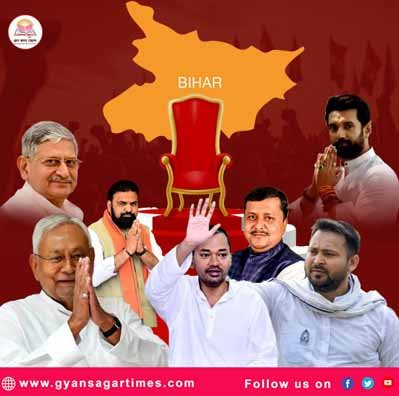
 भारतीय लोकतंत्र की सबसे दिलचस्प और जटिल प्रयोगशाला हमेशा से बिहार ही रहा है. वर्तमान समय में बिहार की राजनीति इस समय एक निर्णायक मोड़ पर है जहाँ दो दशक से सत्ता के केंद्र में रहे नीतीश कुमार ने मुख्यमंत्री पद से दूरी बनाते हुए राज्यसभा की ओर रुख किया है. इस बदलाब से बिहार की राजनीती में शून्य का भाव उत्पन्न हुआ जिसके कारण बिहार में एक नए राजनीतिक ध्रुवीकरण और वर्चस्व की खुली जंग की शुरुआत हो चुकी है.
नीतीश कुमार का राजनीतिक सफर संघर्ष, सीख और असाधारण अनुकूलन क्षमता की गाथा है. वर्ष 1951 में बख्तियारपुर के एक मध्यमवर्गीय परिवार में जन्मे नीतीश पर समाजवादी नेता राम मनोहर लोहिया का गहरा प्रभाव रहा. इंजीनियरिंग की पढ़ाई करने के बाद उन्होंने राजनीति में कदम रखा. वर्ष1974-75 के विद्यार्थी आंदोलन से निकले नीतीश, लालू प्रसाद यादव सहित कई नेता एक ही धरती से उपजे थे, लेकिन उनकी राहें जल्द ही अलग हो गईं. वर्ष 2005 में पहली बार मुख्यमंत्री बनने के बाद से वे सत्ता के केंद्र में थे और उन्हें ‘सुशासन बाबू’ के रूप से भी जाना जाता था. उनकी सबसे बड़ी राजनीतिक उपलब्धि यह थी कि उन्होंने खुद को किसी एक जाति के नेता के रूप में सीमित नहीं रखा, बल्कि उनकी स्वीकार्यता लगभग हर वर्ग में थी.
नीतीश कुमार के एक फैसले से बिहार की राजनीति में जो शून्य पैदा हुआ है, वह केवल एक नेता की कमी नहीं है, बल्कि उस सामाजिक संतुलन का खत्म होना है जिसे उन्होंने बड़ी सावधानी से बनाया था. वर्ष 2023 के जाति सर्वेक्षण के अनुसार, बिहार में ओबीसी और ईबीसी मिलकर लगभग 63% आबादी हैं. नीतीश ने अति पिछड़ा वर्ग (ईबीसी), महादलितों और कुर्मी-कोएरी (लव-कुश) जैसे समुदायों का एक ऐसा व्यापक गठबंधन तैयार किया था, जो पिछले दो दशकों में उनकी सत्ता का आधार भी बना.
जदयू बिहार की राजनीति की धुरी थे नीतीश कुमार. उनके केंद्र जाने के फैसले से एक सवाल खड़ा हो रहा है कि क्या उनके बिना यह समीकरण कायम रहेगा या बिखर जाएगा? वहीं दूसरी तरफ जदयू के सामने अस्तित्व का भी संकट बन रहा है. बताते चलें कि, जदयू पार्टी के पास विधानसभा में 85 विधायक हैं, जो कोई छोटी संख्या नहीं है, लेकिन संगठनात्मक रूप से यह पूरी तरह नीतीश के व्यक्तित्व पर निर्भर थी. वहीँ, जदयू में श्रवण कुमार या विजय कुमार चौधरी जैसे दूसरे दर्जे के नेता तो हैं, लेकिन कोई भी ऐसा चेहरा नहीं है जो पार्टी को एकजुट रख सके और जनता के बीच वैसी पहुँच भी नहीं है.
जदयू पार्टी के सदस्य नीतीश कुमार के बेटे निशांत कुमार को आगे बढ़ाने का फैसला किया है रविवार को पटना स्थित जदयू ऑफिस में पार्टी में उन्हें शामिल किया गया. बताते चलें कि, नीतीश कुमार ने लंबे समय तक अपने बेटे को राजनीति से दूर रखा था. क्या अचानक पार्टी में शामिल होने से वो पिता की विरासत को कितना संभाल पाएंगे ये तो आने वाला वक्त ही बताएगा?
वहीं भाजपा इसे रणनीतिक जीत के रूप में देख रहा है. बताते चलें कि भाजपा के पास विधानसभा में 89 विधायक हैं और वह एनडीए में सबसे बड़ी पार्टी बन गई है. वर्ष 2025 के चुनाव में भाजपा को लगभग 47% वोट मिले थे. वर्तमान समय में भाजपा के सामने भी एक बड़ी चुनौती राज्य में अपना एक मजबूत और स्वीकार्य चेहरा खड़ा करना. ज्ञात है कि, सुशील कुमार मोदी के निधन के बाद से भाजपा के पास कोई ऐसा नेता नहीं था जो पूरे राज्य में पार्टी का चेहरा बन सके. वैसे तो भाजपा ने हाल ही में संकेत दिया है कि, वह नई पीढ़ी के नेताओं पर भरोसा कर रही है – (सम्राट चौधरी को उपमुख्यमंत्री बनाकर और नितिन नवीन को पार्टी का राष्ट्रीय अध्यक्ष ).
वैसे भी भाजपा की रणनीति स्पष्ट है कि नीतीश के जाने से जदयू के कमजोर होने की स्थिति में, वह ईबीसी और अन्य पिछड़े वर्गों के उस वोट बैंक को अपनी ओर खींचना चाहती है. बताते चलें कि, सम्राट चौधरी ओबीसी कुशवाहा समुदाय से आते हैं, जो उन्हें सामाजिक समीकरण में अहम बनाता है. नीतीश को केंद्र में जाने से सबसे बड़ा फायदा किसे मिलेगा? वर्ष 2025 चुनाव परिणाम के अनुसार राजद के नेतृत्व वाले ‘इंडिया’ गठबंधन को लगभग 38% वोट मिले थे, जबकि जदयू के पास अकेले लगभग 12% वोट हैं. अब 12% वोट बैंक पर राजद की भी नजर है. परन्तु राजद के लिए ये राह आसान नहीं होगी चुकि, राजद के सामने सबसे बड़ी चुनौती है उसकी ‘यादव-केंद्रित’ छवि. नीतीश ने वर्षों तक जो ईबीसी वोट बैंक बनाया था उसका एक बड़ा वर्ग कल्याणकारी योजनाओं और मोदी की लोकप्रियता के कारण एनडीए से जुड़ चुका है.
एक तरफ तो तेजस्वी यादव की खुद की राजनीति पर भी सवाल उठ रहे हैं. वहीँ, नीतीश कुमार के राज्यसभा जाने के फैसले पर उनकी प्रतिक्रिया ने उनकी ‘दोहरी राजनीति’ को उजागर कर दिया है. कुछ महीने पहले तक तेजस्वी नीतीश के स्वास्थ्य और नेतृत्व क्षमता पर सवाल उठाते हुए उनसे इस्तीफा मांग रहे थे. वर्ष 2025 की चुनाव के दौरान मुजफ्फरपुर की एक रैली में उन्होंने कहा था कि नीतीश “थक चुके हैं” और “बीमार हैं”. लेकिन जैसे ही नीतीश ने राज्यसभा जाने का फैसला लेते ही तेजस्वी के सुर बदल गये. उन्होंने इसे “भाजपा की साजिश” और “धोखा” बता दिया. अब तो उनकी राजनीतिक विश्वसनीयता पर भी गंभीर सवाल खड़े हो गए हैं.
आने वाले कुछ समय बाद विधान परिषद के चुनाव होने वाले हैं, जहाँ वर्चस्व की लड़ाई देखने को मिलेगी. विधान परिषद का चुनाव इस वर्ष जून और नवंबर में होगा. कुल 17 सीटों के लिए होने वाले इस चुनाव में सत्ता समीकरण को परखने का एक और मौका मिलेगा. खासकर जून में 9 सीटों के लिए होने वाला चुनाव अहम होगा, जिसमें राजद की 2, जदयू की 3 और कांग्रेस की एक सीट शामिल हैं.
राज्य-सभा चुनाव भी दिलचस्प होने वाला है. एक तरफ नीतीश कुमार तो दूसरी तरफ उपेंद्र कुशवाहा. उससे भी बड़ा पेंच यह है कि, एनडीए के पास 202 विधायक हैं, जो 5 सीटों में से 4 को आसानी से जिताने के लिए पर्याप्त हैं (प्रति सीट 41 वोट चाहिए), लेकिन पांचवीं सीट के लिए उसे 3 अतिरिक्त वोटों की जरूरत है. सवाल यह है कि ये तीन वोट कहाँ से आएंगे ! वही दूसरी तरफ विपक्ष के पास 35 विधायक हैं और अगर वह एक उम्मीदवार उतारता है, तो यह मुकाबला और भी दिलचस्प हो जाएगा. अगर यह स्थिति बनती है तो एनडीए को विपक्षी दलों या निर्दलीयों के बीच सेंध लगानी होगी जो लोहे के चने चबाने जैसा होगा.
नीतीश कुमार के केंद्र में जाने के साथ ही बिहार की राजनीति एक नए युग में प्रवेश कर चुकी है वहीँ दूसरी तरफ एक तरफ समाजवाद की पुरानी विरासत (नीतीश-लालू) कमजोर पड़ रही है, तो दूसरी तरफ भाजपा का संगठनात्मक राष्ट्रवाद और तेजस्वी की ‘ए-टू-जेड’ वाली राजनीति आमने-सामने है. नीतीश कुमार के जाने के बाद वर्चस्व की लड़ाई अब तीन स्तरों पर लड़ी जाएगी. एक तरफ जदयू को अस्तित्व बचने की जद्दोजहद करते हुए निशांत कुमार को एक नेता के रूप में स्थापित करना. वहीं भाजपा के लिए विस्तार की लड़ाई होगी, साथ ही राजद को पुनरुत्थान की लड़ाई.
वैसे भी बिहार की राजनीति अनिश्चितता के दौर में प्रवेश कर चुकी है, जहां हर दल अपनी-अपनी रणनीति बनाने में जुटा है. आने वाले विधान परिषद चुनाव और उसके बाद के उपचुनाव यह तय करेंगे कि यह वर्चस्व की लड़ाई किसके पक्ष में जाती है.
संजय कुमार सिंह,
राजनितिक एडिटर
ज्ञानसागरटाइम्स.
========== ========= ===========
The Battle for Supremacy…
Bihar has always served as the most intriguing and complex laboratory of Indian democracy. Currently, Bihar’s politics stands at a decisive crossroads, where Nitish Kumar—who has remained at the epicenter of power for two decades—has stepped away from the Chief Minister’s office to turn his focus toward the Rajya Sabha. This shift has created a political vacuum in Bihar, triggering the onset of a new political polarization and an open battle for supremacy.
Nitish Kumar’s political journey is a saga of struggle, learning, and extraordinary adaptability. Born in 1951 into a middle-class family in Bakhtiyarpur, Nitish was deeply influenced by the socialist leader Ram Manohar Lohia. After completing his engineering studies, he stepped into the arena of politics. Emerging from the student movement of 1974–75, Nitish—along with several other leaders, including Lalu Prasad Yadav—sprang from the same political soil; however, their paths soon diverged. Since becoming Chief Minister for the first time in 2005, he remained at the very center of power and came to be known affectionately as ‘Sushasan Babu’ (The Man of Good Governance). His greatest political achievement lay in the fact that he did not confine himself to being a leader of a single caste; rather, he enjoyed acceptance across almost every social stratum.
The vacuum created in Bihar’s politics by this single decision of Nitish Kumar represents not merely the absence of a leader, but the dismantling of the delicate social equilibrium he had so meticulously constructed. According to the 2023 caste survey, the OBC and EBC communities collectively constitute approximately 63% of Bihar’s population. Nitish had forged a broad-based coalition comprising communities such as the Extremely Backward Classes (EBCs), the Mahadalits, and the Kurmi-Koeri (the ‘Luv-Kush’ alliance)—a coalition that served as the very bedrock of his power over the past two decades.
Nitish Kumar was the central axis around which the politics of the Janata Dal (United)—JD(U)—in Bihar revolved. His decision to shift his focus to the national stage raises a critical question: Will this carefully crafted political equation endure in his absence, or is it destined to crumble? Meanwhile, on the other hand, the JD(U) itself now faces an existential crisis. It’s worth noting that the JDU party has 85 MLAs in the Assembly, which is no small number, but organizationally, it was completely dependent on Nitish’s personality. Meanwhile, the JDU has second-tier leaders like Shravan Kumar and Vijay Kumar Chaudhary, but there is no visible face who can keep the party united and lacks public reach.
JDU members have decided to promote Nitish Kumar’s son, Nishant Kumar, and he was inducted into the party on Sunday at the JDU office in Patna. It’s worth noting that Nitish Kumar had kept his son away from politics for a long time. Only time will tell how effectively his sudden induction will carry forward his father’s legacy.
The BJP, meanwhile, is viewing this as a strategic victory. The BJP has 89 MLAs in the Assembly, making it the largest party in the NDA. In the 2025 elections, the BJP secured approximately 47% of the vote. Currently, the BJP faces a significant challenge in establishing a strong and acceptable face in the state. It is known that since the death of Sushil Kumar Modi, the BJP has lacked a leader who could serve as the party’s face across the state. However, the BJP has recently indicated its focus on a new generation of leaders (by appointing Samrat Chaudhary as Deputy Chief Minister and Nitin Naveen as the party’s National President).
In any case, the BJP’s strategy is clear: should the JD(U) weaken following Nitish’s departure, the party aims to capture the vote bank comprising the EBCs (Extremely Backward Classes) and other backward classes. It is worth noting that Samrat Chaudhary hails from the OBC Kushwaha community, a fact that renders him a pivotal figure within the prevailing social equations. Who stands to gain the most from Nitish’s potential move to the national stage? Based on the 2025 election results, the RJD-led ‘INDIA’ alliance secured approximately 38% of the votes, whereas the JD(U holds a vote share of roughly 12% on its own. Now, the RJD, too, has set its sights on this 12% vote bank. However, this path will not be easy for the RJD, as its most formidable challenge remains its ‘Yadav-centric’ image. A significant segment of the EBC vote bank—which Nitish had painstakingly cultivated over the years—has already gravitated toward the NDA, driven by the appeal of welfare schemes and the popularity of Prime Minister Modi.
On one hand, questions are now being raised regarding Tejashwi Yadav’s own political conduct. On the other hand, his reaction to Nitish Kumar’s decision to seek a seat in the Rajya Sabha has exposed the ‘duplicity’ inherent in his politics. Until just a few months ago, Tejashwi was demanding Nitish’s resignation while casting doubts on his health and leadership capabilities. During a rally in Muzaffarpur ahead of the 2025 elections, he had asserted that Nitish was “exhausted” and “ailing.” Yet, the moment Nitish decided to head to the Rajya Sabha, Tejashwi’s tone shifted dramatically; he proceeded to label the move a “BJP conspiracy” and an act of “betrayal.” Consequently, serious questions have now been raised regarding his own political credibility.
In the near future, elections for the Legislative Council are scheduled to take place—an arena where a battle for political supremacy is expected to unfold. These Legislative Council elections are slated for June and November of this year. Comprising a total of 17 seats, these elections will provide yet another opportunity to test the prevailing power dynamics within the state. The elections scheduled for June—covering 9 seats in total—will be particularly significant, as they involve seats currently held by the RJD (2 seats), the JD(U) (3 seats), and the Congress (1 seat).
The Rajya Sabha elections, too, promise to be an intriguing affair, pitting Nitish Kumar on one side against Upendra Kushwaha on the other. An even greater twist in the tale is that the NDA holds 202 MLAs—a number sufficient to easily secure four out of the five seats (requiring 41 votes per seat)—yet it requires three additional votes to win the fifth seat. The crucial question is: where will these three votes come from? Conversely, the opposition commands 35 MLAs; should they field a candidate, the contest is set to become even more intriguing. If this scenario materializes, the NDA will be compelled to poach votes from either opposition parties or independent legislators—a task akin to cracking a hard nut to swallow.
With Nitish Kumar’s move to the central stage, Bihar’s politics has entered a new era. On one hand, the old legacy of socialism (embodied by Nitish and Lalu) appears to be waning; on the other, the BJP’s organizational nationalism and Tejashwi’s ‘A-to-Z’ brand of inclusive politics now stand in confrontation. Following Nitish Kumar’s departure, the battle for political supremacy will now be fought on three distinct fronts. For the JD (U), it entails a struggle for survival while simultaneously striving to establish Nishant Kumar as a prominent leader. Meanwhile, for the BJP, it marks a battle for expansion, and for the RJD, a battle for resurgence.
In any event, Bihar’s politics has entered a phase of uncertainty, wherein every political party is currently engrossed in formulating its own distinct strategy. The upcoming Legislative Council elections—followed by subsequent by-elections—will ultimately determine in whose favor this battle for supremacy is decided.
Sanjay Kumar Singh,
Political Editor
Gyansagar Times.